
At a Glance
Tonight's sky in autumn 2026 is led by Saturn in the evening and by Jupiter and Mars in the morning, with Venus joining them before dawn from November. The biggest events of the coming year are the Geminid meteor shower on December 14, 2026, the oppositions of Jupiter and Mars in February 2027 and the total solar eclipse of August 2, 2027.
- Evening planet, autumn 2026
- Saturn (opposition October 4, 2026)
- Morning planets, late 2026
- Venus, Jupiter and Mars
- Jupiter opposition
- February 11, 2027, magnitude -2.6
- Mars opposition
- February 19 to 20, 2027, 101 million km (63 million mi) away
- Next eclipse
- Annular solar eclipse, February 6, 2027
On this page
How Do You Find What's in the Sky Tonight?
Start with the what's in the sky tonight tool, which lists the planets, Moon and bright stars above your horizon for your location and time. Then check the Moon phase, because a bright Moon washes out faint stars, meteors and the Milky Way, while the nights around new Moon are the darkest of the month.
A few habits make any night better:
- Wait for real darkness. The sky keeps brightening the west for an hour or more after sunset, as explained in how long it takes to get dark after sunset.
- Look along the ecliptic. Planets always travel near the ecliptic, the Sun's yearly path through the zodiac constellations.
- Watch how it shines. Planets usually shine with a steadier light than stars, which flicker for the reasons in why stars twinkle.
- Protect your night vision. Give your eyes 20 to 30 minutes of dark adaptation and get away from light pollution if you can.
Which Planets Are Visible in Late 2026?
Saturn reached opposition on October 4, 2026, so it rises at sunset and stays up all night in the dim constellation Cetus, glowing at about magnitude 0.3. It remains an evening planet through winter before slipping into the Sun's glare in March.
Venus passes between Earth and the Sun on October 24, then climbs into the morning sky in November as the brilliant morning star. It reaches its greatest distance from the Sun, 47 degrees, on January 3, 2027. Mercury has an evening appearance around October 12, best seen from the Southern Hemisphere, and a morning appearance around November 20 that favors northern observers.
Jupiter and Mars rise in the hours after midnight, Jupiter in Leo and Mars moving from Cancer into Leo, rising earlier and brightening each week. In the dark months they become the main event: Jupiter reaches opposition on February 11, 2027 and Mars on February 19 to 20, closest to Earth at about 101 million km (63 million mi). Uranus, at opposition in Taurus on November 25, needs binoculars. Check tonight's positions on planets visible tonight.
| Month | Highlights |
|---|---|
| October 2026 | Saturn at its best after the Oct 4 opposition; Draconids Oct 8 to 9; Mercury evening elongation Oct 12; Orionids Oct 21; Venus passes between Earth and Sun Oct 24; Hunter's Moon Oct 26 |
| November 2026 | Venus returns as the morning star; Southern and Northern Taurids Nov 5 and 12; Leonids Nov 17; Mercury morning elongation Nov 20; Beaver Moon Nov 24; Uranus opposition Nov 25 |
| December 2026 | Venus at its brightest before dawn; Geminids Dec 14 with a thin crescent Moon; solstice Dec 21; Ursids Dec 22; Cold Moon Dec 24 |
| January 2027 | Quadrantids Jan 4 near new Moon; Venus greatest western elongation Jan 3; Mars and Jupiter brightening in Leo; Wolf Moon Jan 22 |
| February 2027 | Mercury evening elongation Feb 3; annular solar eclipse Feb 6; Jupiter opposition Feb 11; Mars opposition Feb 19 to 20; Snow Moon with a penumbral lunar eclipse Feb 20 |
| March 2027 | Mercury morning elongation Mar 17; equinox Mar 20; Worm Moon Mar 22; Jupiter and Mars high in the evening; Saturn sinks into twilight |
| April 2027 | Saturn passes behind the Sun Apr 7; Pink Moon Apr 20; Lyrids Apr 23 under a bright Moon; Jupiter and Mars in the evening sky |
| May 2027 | Eta Aquariids May 6 at new Moon; Flower Moon May 20; Mercury evening elongation May 28 |
| June 2027 | Strawberry Moon Jun 19; solstice Jun 21; Jupiter and Mars lower in the west after sunset; Saturn in the morning sky |
| July 2027 | Mercury morning elongation Jul 15; Buck Moon with a very slight penumbral lunar eclipse Jul 18; Southern Delta Aquariids and Alpha Capricornids Jul 31 |
| August 2027 | Total solar eclipse Aug 2; Venus passes behind the Sun Aug 11; Perseids Aug 13; Sturgeon Moon with a penumbral lunar eclipse Aug 17; Jupiter passes behind the Sun Aug 31 |
| September 2027 | Aurigids Sep 1; Harvest Moon Sep 15; equinox Sep 23; Mercury evening elongation Sep 24; Neptune opposition Sep 28; Saturn nearing its October opposition |
| Source: JPL Horizons ephemeris (ssd.jpl.nasa.gov), NASA eclipse predictions (eclipse.gsfc.nasa.gov) and IMO 2027 Meteor Shower Calendar, retrieved 2026-10 | |
What Planets Can You See in 2027?
Through spring 2027 Jupiter and Mars ride high in the evening sky, drifting west month by month, while Venus keeps the dawn to itself. Saturn passes behind the Sun on April 7 and returns to the morning sky by late spring, heading for its next opposition in October 2027. Venus fades into the morning twilight in summer and passes behind the Sun on August 11, and Jupiter does the same on August 31.
Mercury, always close to the Sun, offers five more viewing windows: in the evening around February 3, May 28 and September 24, and in the morning around March 17 and July 15. Faint Neptune reaches opposition on September 28, 2027 and needs a telescope. To see how far each world is at any moment, use distance to the planets now, and for background on the terms used here, see conjunction and elongation.
Night Sky Guides Month by Month
Each monthly guide covers Moon phases, planets, meteor showers, eclipses and constellations.
- Night sky in October 2026: Saturn at its best and the Orionids.
- Night sky in November 2026: Venus returns at dawn, Leonids.
- Night sky in December 2026: Geminids under dark skies.
- Night sky in January 2027: Quadrantids and Venus at its farthest from the Sun.
- Night sky in February 2027: Jupiter and Mars at opposition.
- Night sky in March 2027: equinox and a fine morning Mercury for the south.
- Night sky in April 2027: Lyrids and evening giants.
- Night sky in May 2027: Eta Aquariids at new Moon.
- Night sky in June 2027: solstice and the shortest nights.
- Night sky in July 2027: Delta Aquariids and the summer Milky Way.
- Night sky in August 2027: total solar eclipse and the Perseids.
- Night sky in September 2027: Harvest Moon and equinox.
Full Moon dates are collected in the full moon calendar 2026 and full moon calendar 2027, shower dates in the meteor shower calendar 2026, and eclipses on the eclipses page.
Which Stars and Constellations Are Up Tonight?
The stars shift about two hours earlier each month, so the evening sky changes with the seasons. On autumn evenings in the Northern Hemisphere the Summer Triangle sinks in the west while the Great Square of Pegasus and Andromeda climb overhead. Winter brings Orion and the bright stars of the Winter Hexagon, including Sirius, the brightest star in the night sky.
Spring evenings belong to Leo and the Big Dipper, high in the north, and summer nights show Scorpius, Sagittarius and the bright core of the Milky Way. Some stars never set at all from mid-northern latitudes, as explained in what circumpolar stars are. For a full season-by-season list, see constellations by month.
All Night Sky Tonight (13)
 sky tonightNight Sky in April 2027
 sky tonightNight Sky in August 2027
 sky tonightNight Sky in December 2026
 sky tonightNight Sky in February 2027
 sky tonightNight Sky in January 2027
 sky tonightNight Sky in July 2027
 sky tonightNight Sky in June 2027
 sky tonightNight Sky in March 2027
 sky tonightNight Sky in May 2027
 sky tonightNight Sky in November 2026
 sky tonightNight Sky in October 2026
 sky tonightPlanets Visible Tonight
 sky tonightNight Sky in September 2027
Key Facts
- Saturn reached opposition on October 4, 2026 and is the main evening planet of autumn 2026.
- Venus passes between Earth and the Sun on October 24, 2026 and shines as the morning star from November 2026 to summer 2027.
- Jupiter reaches opposition on February 11, 2027 and Mars on February 19 to 20, 2027, both in Leo.
- The Geminid meteor shower peaks on December 14, 2026 under a thin crescent Moon.
- The total solar eclipse of August 2, 2027 is the sky event of the year, with up to 6 minutes 23 seconds of totality.
- The stars rise about four minutes earlier each night, which adds up to about two hours a month.
Frequently Asked Questions
What planets are visible tonight?
In October 2026, Saturn is visible all evening, climbing from the east toward the south, Jupiter and Mars rise after midnight in Leo and Cancer, and Mercury is low in the western twilight. Venus is hidden in the Sun's glare until it reappears before dawn in early November. For the exact view from your location and time, use the sky tonight tool on Supernova Tribune.
What is the bright star in the sky tonight?
If it is a steady, very bright light, it is probably a planet. In the evenings of autumn 2026 that is usually Saturn, and before dawn it is Jupiter or, from November, the far brighter Venus. Among true stars, Sirius is the brightest and dominates winter evenings, rising in the southeast and flashing many colors when it is low.
When is the next meteor shower?
After the Draconids on October 8 to 9, 2026, the Orionids peak on October 21, followed by the Taurids in early November, the Leonids on November 17 and the Geminids on December 14, the strongest shower of the year. Rates are best in the hours before dawn, from a dark site, when the Moon is below the horizon.
When is the next full Moon?
The next full Moons are the Beaver Moon on November 24, 2026, at 14:54 UTC and the Cold Moon on December 24, 2026, at 01:28 UTC. In 2027 the full Moon of February 20 brings a penumbral lunar eclipse. Exact times for each month are listed in the full moon calendars and the monthly sky guides.
When is the best time to stargaze?
The best nights fall within a few days of new Moon, when there is no moonlight to brighten the sky. Wait until at least an hour or two after sunset for the twilight to fade completely, and choose a clear night away from city lights.
Can you see the Milky Way tonight?
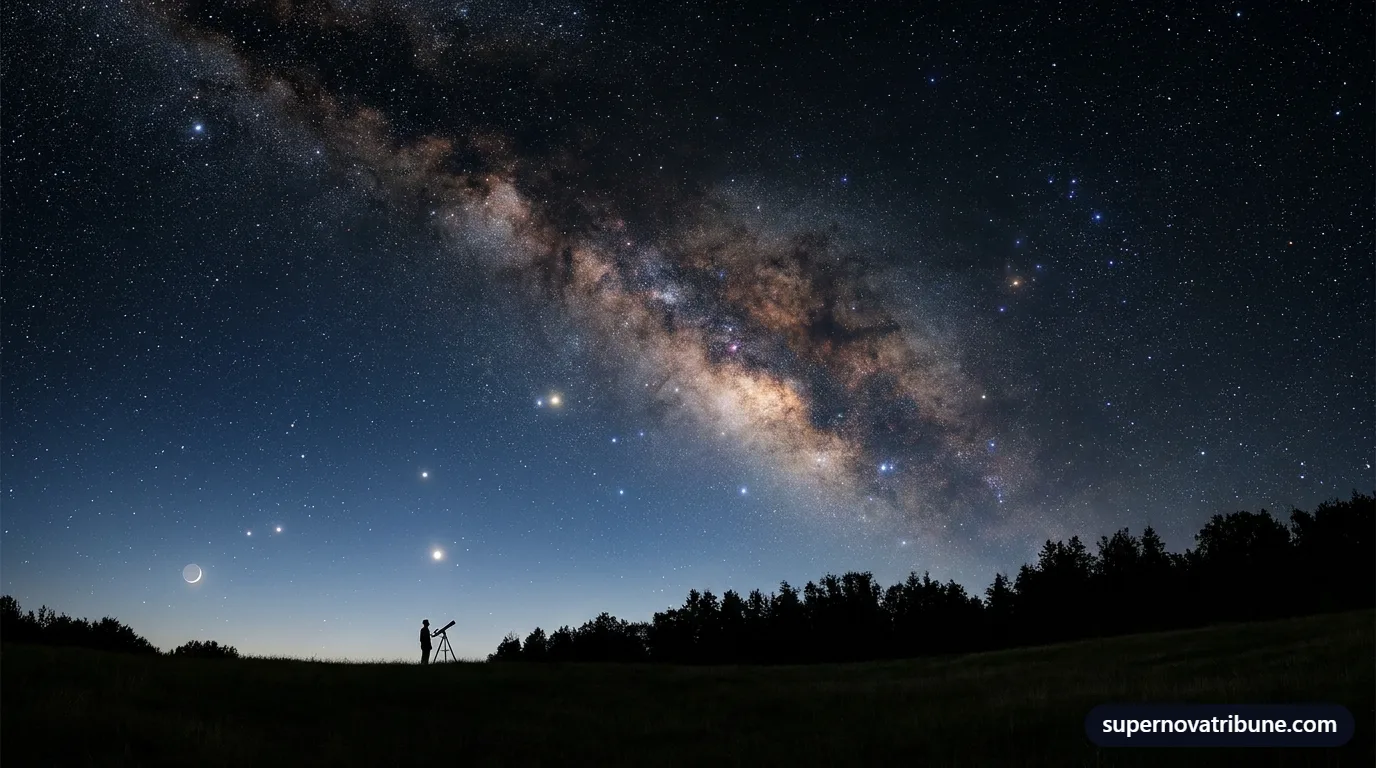
You can if the sky is truly dark and the Moon is down. In autumn the Milky Way arches overhead through Cygnus and Cassiopeia in the evening, and in summer its bright core shines low in the south in Sagittarius. Light pollution is the main obstacle, so drive away from towns, and give your eyes about 30 minutes to adapt.


